
A “huge” challenge
Joel de Jesús Peña Sterling weighs almost 800 pounds. Right now he’s awaiting a surgical procedure expected to let him have a normal life again.
Ana María Domínguez Cruz
digital@juventudrebelde.cu
March 5, 2012 - 21:04:04 CDT
A CubaNews translation.
Edited by Walter Lippmann.
“I came with a newspaper in one hand and my hopes in the other, and now I know I won’t even christen the new underwear I brought in my suitcase, because I arrived like this but I’m confident that I will return to my town Jovellanos a different person… Sure I will!”
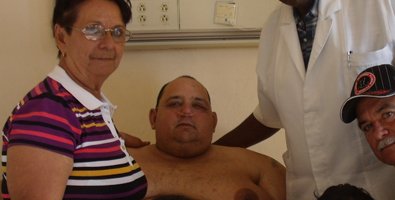
His mother (left), the doctor and the rest of the family long for Joel to start leading a normal life again (Photo: Ana María Domínguez Cruz)
It’s unusual, not to say exceptional, to meet someone like Joel de Jesús Peña Sterling, a cheerful, jolly 43-year-old from Matanzas province whose 800 pounds need not one but two hospital beds in Havana’s Endocrinology Institute.
He says his body is ill, but his mind boasts health and optimism since he was admitted into this ward February 20.
Joel hopes his previous tests and checkups will yield good results so that he can undergo bariatric surgery to lose weight, the reason that he came all the way from his hometown to find Dr. Antonio Portie Félix, whose work he first heard of when he read ¿Cambio de vida? (A change of life?), an item I published in JR on November 2, 2010.
“I’ve got a clipping of your article here,” he told me. “I took it with me when I went to see the doctor and asked him many questions. He said he can operate on me and then follow his treatment to the letter. I’ll wait for as long as I have if it means I’ll be fine and get my life back.
“Look, coming in an ambulance was all but impossible. My family, friends and neighbors put me on a van with back doors wide enough to take a 55-gallon water tank, but it was still hard to fit me in. There were bystanders shouting instructions, like I should spread lard on my belly, for one, and in the end they even came up with this winch-like device that could be hooked onto the doors and lift my body to get it in the van. The onlookers gave me a round of applause and wished me luck, and I told them to take a good look at me because they would not recognize me on my return.
The origin of astonishment
Joel’s mother Irene Teresa Sterling says he always had a few pounds too many, but she never thought he would put on so much weight.
“He was an average kid, neither thin nor fat. At 18 he weighed around 140 pounds. That’s when he went to Angola, where he served with a Motorized Infantry Company, played in a military band, and worked as a driver, and his body never got in the way,” Irene recalls.
The “fat” problem came later, his uncle Cirilo Sterling remarks. Joel studied Civil Construction and worked for a while, but then he decided to become self-employed and opened a pizza place. At first he did all the cooking, something he really loves.
“Soon, however, I was eating up to ten pizzas every day in addition to my regular meals and traveled around by car every time I needed to take care of my something workwise. On top of that, I would spend a lot of time in front of my computer, which is not precisely a physically demanding activity,” Joel points out.
Unwilling to exercise or eat less, he kept gaining more and more weight. “I took no notice of my mother’s or anybody else’s advice and went increasingly careless. The last time I managed to step onto a scale a year ago I was weighing 650 pounds, and this is what my life has been like since.”
Around that time he was found to have insulin-dependent diabetes and other disorders, mainly respiratory problems, and on May 19 last year his condition got worse, his mother adds.
“He not only had a sedentary lifestyle, he also ate too much. That day we had a family problem and Joel became very depressed. As a result, his feet could no longer support his body and he had to stay in bed or sit on a nearby armchair at best, but kept wolfing down food, so further complications arose. Given his steady weight gain, we figure he must be weighing around 800 pounds now,” she underscored.
It was not until he read the aforesaid article ¿Cambio de vida? that Joel really came to terms with his plight and realized that surgery was the only solution, according to long-time friend Irán Rodríguez.
“It took a while anyway because he always thought things would work out in the end, but his life has deteriorated considerably. That’s why we decided, phone in hand, arrangements under way and his condition stable, that we had to take him out of Jovellanos and not stop until we arrived here,” he added.
A matchless challenge
“People aged 18 to 60 who suffer from severe or morbid obesity like Joel’s –or even a milder, non-endocrine-related case for more than five years– who have failed in their attempts to lose weight either by means of a pharmacological or hygienic-dietetic treatment or through physical exercise, meet the requirements for bariatric surgery,” assures Calixto García Hospital’s Bariatric Surgery Multidisciplinary Group director Dr. Antonio Portie Félix, “except if the patient is a chronic alcoholic, has a mental disorder or does drugs.
“Bariatric surgery follows traditional methods to bring the patient’s body weight down through cuts and pleats to reduce their stomach capacity, a procedure against too much food absorption, or a combination of both in a sort of mixed operation.
“You can use simple or complex techniques, including bypass and gastric or bilious-pancreatic anastomosis. The latter is based on two methods that I created and patented, called Portie I and II, applied to each patient according to their personal characteristics,” the surgeon says. “Neither needs cuts but both reduce the stomach capacity –so that less food is ingested– and involve splitting the small bowel into two parts, one to carry the food coming from the stomach and the other for the pancreatic, gastric and proximal intestinal juices, so as to keep food from passing through most of the stomach and the duodenum.
“The two separate sections of the small bowel are connected at the cut end by means of a Roux-en-Y, at a distance of 50 to 120 centimeters from the beginning of the large bowel, where food mixes with digestive juices and the rate of absorption of fats and other nutrients is reduced. This is possible with either Portie I or II, except that with Portie II –used in patients with a not-so-serious degree of obesity– you don’t fold the stomach’s greater curvature,” Dr. Portie Félix points out.
He adds that Joel’s body mass index, and therefore his degree of obesity, are yet to be established –dividing the individual’s body mass in kilograms by the square of his or her height– so it’s clear that he needs Portie I surgery.
“Joel is a big surgical and biological challenge on many accounts. The existing literature has it that people of this weight usually die from related complications before they turn 40. His will be my first operation on such a disorder.”
“Is bariatric surgery his only option?”
“There’s no question about it. Only one of every ten individuals with morbid obesity can lose weight through diet and exercise. The rest have very unstable effects, and surgery is their only choice.
“We still have to wait for the Electromedicine Division’s help, because we don’t have any operating table that is sufficiently strong to support Joel’s weight during the procedure. They’re making some accessories to place him in the three necessary height and lateral positions.
“Nevertheless, surgery isn’t magic, and Joel is aware of that. All these efforts will be worthless if he fails to follow our instructions throughout the postoperative period, that is, a lifestyle based on a strict, balanced diet and physical exercise on the side designed to make him lose one-to-two kilograms per day the first month and then one per day in the following months,” stressed the doctor.
Once Joel recovers a healthy weight he can think about reconstructive surgery to get rid of the excess skin on his neck, arms and thighs and be able to move and perform better. He will have a normal, productive and social life again, and probably think twice before he lets himself be carried away on New Year’s Eve or any other celebration.
“Will you have as much willpower as it takes to live with these restrictions?”, I ask Joel.
“I sure will! I’m telling you, journalist… You showed me the way and here I am. When you see a fat guy who looks like me, look again, and you’ll see it’s someone else.
“I lacked the willpower before, but now I have enough and to spare. I’ve had a lot of support and been treated very well, and for once I’m full of something healthy: the faith I need,” Joel assures me.
http://www.juventudrebelde.cu/ciencia-tecnica/2012-03-05/un-desafio-gordo-/
Un desafío «gordo»
Joel de Jesús Peña Sterling tiene cerca de 800 libras de
peso. En estos momentos espera
por una cirugía que le permita comenzar el regreso a una vida normal
Ana María
Domínguez Cruz
digital@juventudrebelde.cu
5 de Marzo del 2012 21:04:04 CDT
«Vine con el periódico en una mano y las esperanzas en la otra y sé que
esos calzoncillos nuevos que traje en el maletín ni me los voy a
estrenar, porque llegué así, pero tengo fe en que regresaré a Jovellanos
siendo otro… Seguro que sí».
Pocas veces, para no decir que excepcionalmente, se conoce a alguien
como Joel de Jesús Peña Sterling, un matancero jovial y jaranero, de 43
años, que con cerca de 800 libras de peso ocupa nada menos que dos
camas, las 17 y 18, en una de las salas del Instituto de Endocrinología,
en La Habana.
Mi cuerpo está enfermo, dice él, pero su mente muestra estar sana,
optimista, desde que el pasado 20 de febrero llegó a la institución
capitalina.
Joel espera que los análisis y exámenes previos arrojen buenos
resultados para que pueda someterse a la cirugía bariátrica, y con esta
reducir su peso corporal. Ese fue el motivo por el que se trasladó desde
su pueblo hasta acá, siguiéndole la pista al doctor Antonio Portie Félix,
de cuya existencia conoció en el trabajo publicado por esta reportera en
JR
con el título ¿Cambio de vida?, el 2 de noviembre de 2010.
«Aquí tengo recortada la hoja del artículo —dice—, y lo muestra. Con
esta busqué al doctor y le hice todas las preguntas. Él puede operarme,
me explicó, y después me toca a mí seguir sus orientaciones al pie de la
letra. Ahora espero lo que tenga que esperar con tal de que todo salga
bien y pueda volver a tener una vida normal.
«Mire, venir en una ambulancia fue casi imposible. Mi familia, mis
amigos y los vecinos me montaron en una camioneta, en la que por la
puerta cabe un tanque de 55 galones.
Aun así fue difícil, la gente gritaba que me echaran grasa en la barriga
para poder entrar, y al final inventaron hasta un mecanismo similar a
una polea, y con unos cantos en la puerta, me subieron. Todos los que
estaban mirando aplaudieron y me gritaron cosas buenas. Por eso les dije
que se fijaran bien en mí, que cuando regresara de La Habana no me iban
a reconocer.
Origen de un asombro
Cuenta Irene Teresa Sterling, la mamá de Joel, que aunque siempre fue un
niño con libritas de más, nunca pensó que pudiera engordar tanto.
«Era un muchacho de peso promedio, ni flaco ni obeso. Con 18 años pesaba
140 libras, aproximadamente, cuando viajó a Angola. Allá integró la
Compañía de Infantería Motorizada, una banda de música y sirvió como
chofer. Todo pudo hacerlo sin impedimento físico», detalló Irene.
El problema «gordo» vino después, comenta su tío Cirilo Sterling, pues
Joel estudió Construcción civil y luego de un tiempo de trabajar en ese
especialidad, decidió abrir una pizzería como negocio por cuenta propia.
Al principio él era quien cocinaba, pues le gusta mucho.
«En esos días comía hasta diez pizzas diarias, además de la comida. Me
trasladaba en el carro si tenía que hacer alguna gestión, y como tiempo
después tuve una computadora, incursioné bastante en el mundo de la
informática, que es un trabajo muy pasivo», narró Joel.
Sin el ánimo de hacer ejercicios ni de controlar su alimentación,
aumentaba su peso con rapidez. «No le hacía caso a mi mamá ni a nadie
que me alertara por todo lo que comía; me descuidé demasiado. Hace un
año estaba por las 650 libras, que fue la última vez que pude pesarme, y
desde entonces hasta acá he hecho mi vida así».
Hace igual tiempo debutó como diabético insulinodependiente y con otras
afecciones, sobre todo respiratorias, añade su mamá, quien especifica
que a partir del 19 de mayo del año pasado la situación de su hijo
empeoró.
«Él mantenía una vida sedentaria, y además de eso, comía mucho. En esa
fecha tuvimos problemas familiares y Joel se deprimió bastante. Como
consecuencia, sus pies ya no pudieron sostenerlo. Su vida se limitó
entonces a permanecer en cama y cuando más, en el butacón cerca de esta,
sin dejar de comer; así, más complicaciones le fueron apareciendo y dado
su aumento progresivo de peso, estimamos que esté ahora alrededor de las
800 libras», agregó.
No fue hasta que leyó el trabajo ¿Cambio de vida? que realmente Joel
asumió su estado como el de una de esas personas que tiene en la cirugía
su única salvación, refiere su amigo Irán Rodríguez.
«Nos demoramos de todos modos, porque él siempre pensó que las cosas
podían solucionarse, pero ya su vida se ha deteriorado mucho. Por eso,
con el teléfono en la mano, las gestiones pertinentes en camino y su
estado estable, decidimos que había que sacarlo de Jovellanos y que
hasta aquí no nos paraba nadie», añadió.
Reto inigualable
Las personas de entre 18 y 60 años que padezcan una obesidad severa o
mórbida, como Joel, o incluso una menor durante más de cinco años, sin
origen endocrino, y que hayan fracasado en su intento por bajar de peso,
ya sea por tratamiento farmacológico, higiénico-dietético o por
ejercicios, reúnen los requisitos para aspirar a la cirugía bariátrica.
Así explicó el doctor Antonio Portie Félix, jefe del Grupo
Multidisciplinario de Cirugía Bariátrica del Hospital Calixto García,
quien insiste en que el paciente no debe padecer alcoholismo crónico,
trastornos psiquiátricos ni drogadicción.
«La cirugía bariátrica se realiza por métodos tradicionales y su
objetivo es disminuir el peso corporal del paciente mediante la
reducción de la capacidad del estómago con cortes o plicaturas, la
actuación sobre la absorción de los alimentos o la combinación de ambos
procederes, lo que la hace una cirugía mixta.
«Pueden emplearse técnicas simples o complejas, entre estas el by pass,
la derivación gástrica y la derivación biliopancreática. Forman parte de
esta última las técnicas Portie I y II, creadas y patentadas por el
especialista, que toman en cuenta las especificidades de cada paciente»,
explicó el cirujano.
Ambas técnicas —añadió— reducen la capacidad estomacal, sin cortar, para
que se ingiera menos comida, y se realiza una separación del intestino
delgado en dos partes, una de las cuales se une al estómago para
transportar los alimentos, y la otra se limita a los jugos pancreático,
biliar e intestinal proximal, con lo que se evita el paso de los
alimentos a través de una gran parte del estómago y el duodeno.
«Las dos partes separadas del intestino se unen en la parte terminal del
intestino delgado a través de una Y de Roux, a una distancia de entre 50
y 120 centímetros del inicio del intestino grueso, uniéndose de esta
forma los alimentos con los jugos digestivos. Así se reduce la absorción
de grasa y de otros nutrientes, tanto con la Portie I como con la II. La
diferencia solo se establece en que en esta última, realizada en
pacientes cuyo grado de obesidad no es tan grave, no se realizan
pliegues de la curvatura mayor del estómago», puntualizó Portie Félix.
En el caso de Joel, apuntó el especialista, a quien no se le ha podido
determinar aún su grado de obesidad mediante el cálculo del Índice de
Masa Corporal, es decir, dividiendo el valor de su peso corporal en
kilogramos, entre el valor de su estatura en centímetros, al cuadrado,
es incuestionable que amerita una técnica quirúrgica Portie I.
«Joel es un gran desafío quirúrgico y biológico, por muchas razones. En
la literatura universal consta que las personas que arriban a este peso
generalmente no sobrepasan los 40 años, pues fallecen antes debido a
diversas complicaciones relacionadas. En mi caso, todavía no he
intervenido a ningún paciente con esta situación».
—¿Es la cirugía
bariátrica su única opción?
—Es incuestionable que sí es su única alternativa, pues solo una de cada
diez personas con obesidad mórbida es capaz de perder peso mediante
dietas y ejercicios; el resto presenta efectos muy inestables y debe
recurrir a esta.
«Todavía debemos esperar a que los compañeros de Electromedicina nos
ayuden, pues no contamos con una mesa de operaciones capaz de soportar
el peso de Joel durante la intervención. Ellos elaborarán unos
aditamentos que permitirán colocarlo en las tres posiciones de altura y
lateral necesarias.
«Sin embargo, y eso Joel lo sabe ya, la intervención quirúrgica no es
mágica. Si no respeta las indicaciones postoperatorias, es decir, un
régimen de vida basado en una dieta restringida y balanceada y
ejercicios físicos que la complementan, con el objetivo de perder de uno
a dos kilogramos diarios en el primer mes, y luego solo uno al día en
los meses posteriores, no habrá valido la pena tanto esfuerzo», enfatizó
el doctor.
Después que Joel recupere su peso saludable podrá someterse a una
cirugía reconstructiva o de rescate para eliminar los excesos de piel en
el cuello, brazos, piernas, muslos… que le dificulten la movilidad y el
desempeño de sus actividades. Volverá a tener una vida normal,
productiva y social, y quizá lo piense mejor antes de excederse en las
cenas de fin de año o en alguna que otra celebración.
—¿Tendrás la
fuerza de voluntad que necesitas para cumplir con esas restricciones?,
le pregunto a Joel.
—Por supuesto… Ya le digo, periodista… Con usted se me abrió el camino y
aquí estoy. Cuando vea a un tipo gordo parecido a mí, ¡mírelo bien!,
porque ese no voy a ser yo.
«La fuerza de voluntad que no tuve antes ya la tengo de sobra. Me han
ayudado mucho, me han tratado muy bien, y la fe que necesito me llena,
que así sí que es saludable», afirmó Joel.