CUBA-USA

The Audacity of a Revolution
Witness and leading participant, Ramón Sánchez-Parodi has published a book in which he examines various aspects of the relations between the two countries.

By: MARTA G. SOJO (inter@bohemia.co.cu )
Photos: EDUARDO LEYVA BENÍTEZ (foto@bohemia.lco.cu)
(01 June  2011)

A CubaNews translation. Edited by Walter Lippmann.

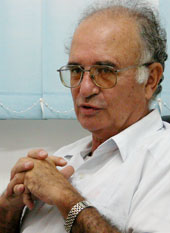
Ramón Sánchez Parodi MontotoRamon Sanchez-Parodi Montoto
Headed the Cuban Section of Interests
in Washington DC from September 1977
to April 1989.


He is considered an insightful analyst of US policy, a standing he has attained after long years of study of that nation’s problems and based also on his diplomatic experience acquired mostly in Washington, DC as Head of the Cuban Interests Section.

His book Cuba–USA, Diez tiempos de una relación, explains the profound reasons behind the inter-relationship between both nations. His living testimony is a detailed and well-informed account of his 12 years in the North American capital.  

Ramón Sánchez-Parodi Montoto took part in the negotiation process that permitted the establishment of Interests Sections in the respective countries. Back in Havana, he was Deputy Foreign Minister, Cuban Ambassador to Brazil and Deputy Director of the José Marti Program, directed by Armando Hart D
ávalos. As a journalist and writer he has published articles in Granma newspaper, and in other national and international media.  

The present work, as highlighted on the back-cover, is particularly focused on bilateral differences. Based on documents and his personal experiences, he delves into the hostility of Yankee imperialism against a people which rejects domination, a feeling contained in its watchword Patria o Muerte.

What is the thesis on the relations between the two countries that you wish to substantiate in your book? 

Portada del libro Cuba-USA, Diez tiempos de una relación, de Sánchez-ParodiOcean Sur Press published Cuba, diez tiempos
de una relación
, a book by Sanchez-Parodi.

The key and essential element is to highlight that –contrary to what is commonly said that relations between Cuba and the United States  are bitter since the triumph of the Revolution, the fact is that
they’ve been so for more than 200 years -- ever since the US emerged as an independent nation,-- due to the persistent intention of the dominant forces of yesterday and today to exert control over Cuba and even physically capture the Island. That is the central thesis.

Do you think that Jose Marti foresaw the impending future as to our relations with US governments?


Marti not only foresaw the future; he clearly defined the roots of the problems and challenges that the independence from colonial rule meant for the Latin American countries and Cuba itself. In our case, and very concretely based on the experiences of the 10 Years War, he pointed to the need to achieve unity and the participation of all the country’s forces in the struggle for independence. I think this is one of the most outstanding contributions Marti made. He was able to unravel the origins, conditions, circumstances and perspectives for the United States to exert what we have hitherto known as domination and imperial policy in the modern sense. This was something Lenin later on described in different terms. Marti also foresaw the importance that the independence of Cuba had for Latin America, something that was largely frustrated at the end of the 19th century and beginnings of the 20th by the US intervention in the Spanish–Cuban war. After the Revolution, the important role of our country in blocking imperial ambitions of the US in our continent has become apparent.

There have been 10 US Presidents since January 1st 1959 and full relations have never been re-established. Could Obama be the exception that brings about a change?   


I don’t know if Obama can be the exception. What is really obvious is that if there is no change the US is faced with a total failure after 50 years and 10 Presidents. He has no other option but to modify his policy. In any case, Obama has the chance of bringing about that change but I’m not sure whether he will waste that opportunity or not; up to now he doesn’t seem very keen on making the inevitable correction.

Why do you believe that blockading and isolating Cuba is a big mistake of US policy?

Valla con la imagen de Fidel Castro y el lema Patria o muerte, venceremosValla con la imagen de Fidel Castro y el lema Patria o muerte, venceremosThe foreign policy of revolutionary Cuba has had an international impact that goes beyond its small dimensions as an island due to its audacious defense of the sovereignty, independence and integrity of the nation.

Among other reasons, because it has utterly failed in its pretentions of dominating and coercing Cuba. It is also a big mistake because it has marked and made things difficult for the United States in its own relations with Latin America, since they tried to associate the governments of the region with their attacks against the island. They did succeed at a given moment, but in the end it’s been a big mistake that has prevented them from developing a constructive relationship with all the Latin American and Caribbean sectors.

The TV series Las razones de Cuba [Cuba's Reasons] has illustrated a few elements of how they’ve tried to insist on the policy of hostility, but it has constantly floundered and after each failure they have devised a new modality that has met the same fate. Right now they are isolated. Therefore the only thing left [for them] to do is to change that policy. If they don’t, they will lose any chance of introducing a beneficial influence in the process together with the rest of the nations in this continent. That is the current state of affairs at this moment. There is no alternative other than changing that stance. Failing to do so will imply sinking deeper into the quagmire of incapacity and impotence.

Do they still cling to the theory that once the historic leaders of the Revolution are gone it will be a different story?

Not even that theory is sustainable, because it is clear that the Commander-in-Chief does not hold any posts in the structures of the Cuban government and state and nothing has happened. The process enters a new phase in keeping with the times.  Proof of this is the Sixth Congress of the Party and the new wave of young leaders, which is a fact of today not of tomorrow. So that moment is gone. The Revolution, on the contrary, becomes stronger in these new circumstances.

In your book you argue that the United States is losing the capacity to conduct an imperial policy. Would you care to comment? 


Ramón Sánchez-Parodi MontotoSánchez-Parodi plans to write a series on the 2012 US presidential election

The US imperial power is undoubtedly declining. Today I was reading an interview with Noam Chomsky where he speaks in those terms: how his country has been losing that capacity since the end of the 2nd World War when the US represented 50 per cent of the world’s economy. Today its prevalence is solely in the military field. But as Fidel Castro has pointed out, it is practically suicidal for the US to employ all of its nuclear might to impose its imperial power; it would endanger the very existence of humanity. Therefore, rationality is the only way out: to acknowledge the realities of the present day world and the need to abandon the hegemonic ambitions that the dominant forces try to pursue. 

For 12 years you were in charge of the Cuban Interests Section in Washington DC. Which were the most difficult or conflictive moments?

I wouldn’t say one was more serious than the other; they were all part and parcel of the same process, they were all significant and carried a lot of weight in this experience.

You have been a diplomat for many years. Do you feel this gave you the opportunity to witness or be part of special circumstances?

I think we have all been present at special moments in the history of Cuba.  Having lived through a revolutionary process means having gained the experience of what a profound revolution really is, a revolution that has stood up to the most powerful enemy the world has ever known. In diplomacy and outside diplomacy I think we’ve all had the honor of living and learning within this process.

In your view, which have been the most important diplomatic battles Cuba has fought in the UN and in Washington DC?

Playa Girón [the Bay of Pigs],  the October Crisis [Missile Crisis of 1962, ed.], the defense of our independence at a time when the US threatened to use even nuclear weapons… Those were all transcendental moments, important battles, but none more important that the other; they were all necessary and played a part in keeping our independence, integrity and sovereignty. 


http://www.bohemia.cu/2011/06/01/nacionales/parodi.html


CUBA-USA

La audacia de una Revolución

Testigo y protagonista, Ramón Sánchez-Parodi, ahora publica un libro donde analiza aspectos sobre las relaciones entre ambos países

Por: MARTA G. SOJO (inter@bohemia.co.cu)
Fotos: EDUARDO LEYVA BENÍTEZ (foto@bohemia.lco.cu)
 

(01 de junio de 2011)

Ramón Sánchez Parodi MontotoRamón Sánchez-Parodi Montoto
fue jefe de la Sección de Intereses
de Cuba en Washington desde el
primero de septiembre de 1977
hasta abril de 1989

Lo consideran un analista agudo de la política de Estados Unidos. Reconocimiento que se ha ganado por su larga data dedicado al estudio de las problemáticas de esa nación y, al propio tiempo, por su experiencia en la labor diplomática, una gran parte de ella en Washington D.C., como jefe de la Sección de Intereses de Cuba.

Cuba-USA, Diez tiempos de una relación es el libro en el cual cuenta las razones profundas de la interrelación entre ambas naciones. Su testimonio es un minucioso examen, con un gran contenido informativo y existencial adquirido en su labor durante 12 años en la capital norteamericana.

Ramón Sánchez-Parodi Montoto, tiene en su haber la participación en el proceso de negociaciones que dio lugar al establecimiento de las llamadas secciones de intereses en cada país. Con posterioridad, fue viceministro de Relaciones Exteriores, embajador de Cuba en Brasil y vicedirector de la Oficina del Programa Martiano, bajo la dirección de Armando Hart Dávalos. Como periodista y escritor ha publicado artículos en el periódico Granma, y en otras editoriales nacionales e internacionales.

En el presente volumen —como se explica en su contraportada— trata con particular atención el tema del diferendo bilateral; apoyándose en documentos y sus vivencias personales, profundiza en la hostilidad del imperio yanqui y la contrapartida de un pueblo que se resiste a tal dominio, con un sentimiento sintetizado en su disyuntiva de Patria o Muerte.

-¿Cuál es la tesis que quiere fundamentar en su libro sobre las relaciones entre los dos países?
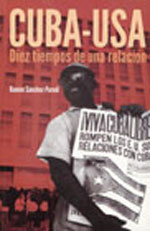
Portada del libro Cuba-USA, Diez tiempos de una relación, de Sánchez-ParodiLa editora Ocean Sur publicó
Cuba-USA, diez tiempos
de una relación
, obra escrita
por Sánchez-Parodi

-El elemento esencial y clave de esto es destacar que, a diferencia de lo que se dice comúnmente, que las relaciones entre Cuba y Estados Unidos están malas a partir del triunfo de la Revolución, la realidad es que lo están desde que ellos surgieron como nación independiente, por más de 200 años, debido a la persistencia del interés de las fuerzas dominantes, tanto las de antes, como después, de ejercer un control sobre Cuba, incluso de apoderarse físicamente de la Isla. Esa es la tesis central.

-¿Considera que José Martí pronosticó el futuro que se nos avecinaba en lo referente a nuestro trato con los gobiernos norteamericanos?

-No es que Martí avizoró el futuro. Es que determinó claramente cuáles eran las raíces de los problemas y los retos que representaron para los países de América Latina y para la propia Cuba el proceso de independencia del poder colonial. Y en el caso de Cuba muy concretamente basado en las experiencias de la guerra de los 10 años, la necesidad de lograr la unidad y el concurso de todas las fuerzas del país para la lucha por la independencia. Creo que ese es uno de los más importantes aportes que el Apóstol brindó. Martí pudo desentrañar los orígenes, las condiciones, las circunstancias y las perspectivas de que Estados Unidos ejerciera lo que después hemos conocido como un dominio y una política imperial, en el sentido moderno, que posteriormente fundamentó ya de otra manera el propio Lenin.

“En tercer lugar pudo prever la importancia que tenía para América Latina la independencia de Cuba, frustrada en gran medida a finales del siglo XIX y principios del XX, por la intervención norteamericana en la guerra hispano-cubana; con el poder revolucionario se ha manifestado la importancia que ha tenido nuestro país para cerrarle el camino a las ambiciones imperiales de EE.UU. en nuestro continente”.

-Han pasado 10 presidentes norteamericanos desde el primero de enero de 1959 y nunca se han logrado restablecer las relaciones plenas. ¿Podría todavía Obama ser la excepción para el cambio?

-No sé si Obama pueda ser la salvedad. Lo que sí está claro es que si no hay cambio Estados Unidos está abocado a un fracaso total después de 50 años y 10 presidentes. No tiene otra opción que modificar su política. Obama, en todo caso, tiene la oportunidad de producir ese cambio, pero no sé si malgastará esa oportunidad; hasta ahora no parece muy decidido a hacer la corrección ineludible.

-¿Por qué estima que bloquear y aislar a Cuba constituye un gran error en la política estadounidense?
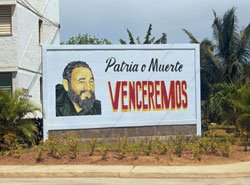
Valla con la imagen de Fidel Castro y el lema Patria o muerte, venceremosLa política exterior de Cuba revolucionaria ha
tenido una connotación internacional que desborda
su pequeñez insular, debido a la audacia con que
ha defendido la plena soberanía, la independencia
y la integridad de la nación

-Entre otras cosas porque ha fracasado totalmente en cuanto a sus pretensiones de dominación y de ejercer influencia en Cuba en todo. Es un error también porque ha marcado y ha creado dificultades a Estados Unidos en sus propias relaciones con América Latina, ya que intentaron sumar a los gobiernos del área a sus ataques contra la Isla, algo que en un momento determinado lograron, pero al final ha sido un error, que les ha impedido desarrollar una relación constructiva con todos los sectores hispanoamericanos y del Caribe.

“En la serie televisiva Las Razones de Cuba se han estado dando algunos elementos de cómo han tratado de aferrarse a la política de hostilidades, pero esta constantemente ha ido naufragando, pensando a partir de cada fracaso una nueva modalidad, y todas los llevan al mismo desenlace. En estos momentos están aislados. Por tanto, lo único que les queda es cambiar esa política. Si no la cambian perderán posibilidades de ejercer una influencia beneficiosa en el desarrollo con el resto de las naciones en este continente.

“Ese es el estado en que se encuentra la situación en estos instantes; no tienen otra solución que cambiar posturas, pues no cambiarlas significa seguir hundiéndose en el pantano de la incapacidad y la impotencia.”

-¿Acaso permanecen aferrados a la teoría de que al morir los dirigentes históricos de la Revolución otro gallo cantará?

-Ya ni esa teoría la pueden sustentar, porque está claro que en el presente el Comandante en Jefe no ocupa cargos en la estructura del Gobierno y Estado cubanos y nada ha pasado. El proceso  entra en una nueva etapa acorde con estos tiempos. Una muestra la vemos en el desarrollo del Sexto Congreso del Partido. Y también, en la nueva hornada de dirigentes jóvenes, que ya es un hecho real, no del futuro. Así que ese momento pasó. La Revolución, al contrario, se fortalece en estas nuevas circunstancias.

-Usted afirma en el libro que se está dando la pérdida de capacidad de Estados Unidos de ejercer una política imperial. ¿Razones?
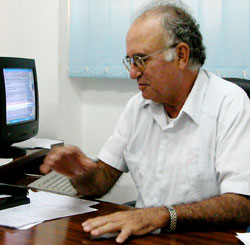
Ramón Sánchez-Parodi MontotoSánchez-Parodi tiene el proyecto de redactar
una serie sobre las elecciones presidenciales
estadounidenses en 2012

-El poder imperial estadounidense, no hay duda, está en declive. Hoy mismo leía una entrevista en la cual Noam Chomsky hablaba en esos términos: cómo su nación ha perdido esas capacidades desde el fin de la II Guerra Mundial, cuando su economía representaba el 50 por ciento de la mundial. Ahora, donde único le queda una preponderancia es en el sector militar. Pero, como apuntara Fidel Castro, es prácticamente suicida el que pretenda utilizar todo el poderío nuclear para ejercer su poder imperial. Algo que pondría en peligro la existencia de la humanidad. Por lo tanto, la sensatez es el único camino abierto, y reconocer las realidades del mundo actual y la necesidad de abandonar esas ambiciones hegemónicas que las fuerzas dominantes tratan de ejercer.

-Durante 12 años dirigió la Sección de Intereses de Cuba en Washington. ¿Cuáles cree que fueron los momentos más difíciles o conflictivos?

-Yo no diría que hubo uno más que otro, sino que todos han sido parte inseparable e integral del mismo proceso; todos fueron trascendentes y de mucho peso en esta experiencia.

-Lleva muchos años de diplomático. ¿Considera que eso le dio la oportunidad de presenciar o participar en circunstancias especiales?

-Creo que todos hemos estado en momentos especiales en la historia de Cuba. El haber vivido el proceso revolucionario es haber podido tener una experiencia de lo que es una revolución profunda, una revolución que ha sabido resistir al enemigo poderoso del mundo en toda la historia. En la diplomacia y fuera de la diplomacia creo que todos hemos tenido la honra y el gran aprendizaje de haber vivido dentro de este proceso.

-En su criterio, ¿cuáles han sido las batallas diplomáticas más importantes de Cuba en la ONU y en Washington?

-Girón, la Crisis de Octubre, la defensa de nuestra independencia en momentos en que EE.UU. nos ha amenazado con usar hasta el arma nuclear… Todos han sido instantes trascendentes, batallas importantes, pero no más importantes unas que otras; todas han sido necesarias, y han desempeñado su papel en mantener la independencia, la integridad y la soberanía.